Questioning “Settled Science” in Health
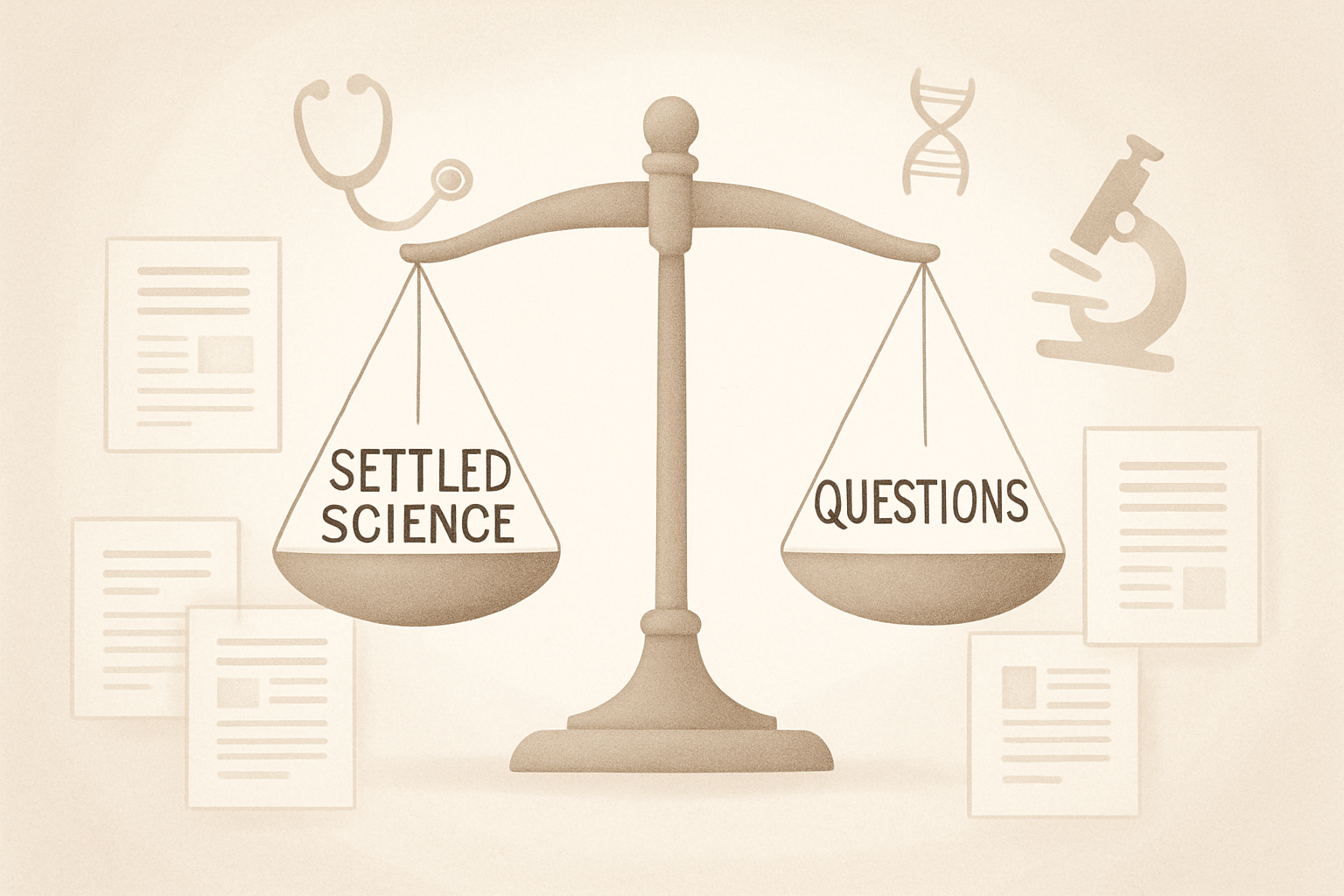
There are very few topics in the health sciences that are “settled,” which is meant to imply that there is no further need to investigate that topic. We should use sunscreen to prevent skin cancer and thus prolong our lives, right? A very large study involving over 30,000 Swedish women found a very significantly higher risk of death among those with lowest daily sun exposure vs highest. Strikingly, the authors state in that study, “We draw the conclusion that low sun exposure is a risk factor for death in the same magnitude as smoking.”
Examining Saturated Fat and Mortality
What else is “settled science?” Saturated fat intake increases your risk of dying? Not according to a large meta-analysis of studies published in the prestigious British Journal of Medicine.
I’m not suggesting there are no studies showing sun exposure is a risk of greater mortality. Ditto for saturated fat intake. The point is that the science around these topics is not “settled.” For any given finding within the body of published science today, tomorrow could see a published finding that questions or even directly contradicts it.
The Vaccination and Autism Debate
It is within this context that I am baffled by doctors – doctors, of all people! – adamantly opposing a rigorous investigation into a link between childhood vaccinations and autism, claiming that the “science is settled” on this topic so there is no need to investigate it further.
Example Studies on Vaccines and Autism
“In phase II, it was observed that cases diagnosed with an ASD [autism spectrum disorder] were significantly more likely than controls to receive increased organic-Hg from Thimerosal-containing hepatitis B vaccine administered within the first, second, and sixth month of life.” Study linked here.
“The higher the proportion of children receiving recommended vaccinations, the higher was the prevalence of AUT [autism] or SLI [speech or language impairment]. A 1% increase in vaccination was associated with an additional 680 children having AUT or SLI.” Study linked here.
“Furthermore, over 90% of MMR antibody-positive autistic sera were also positive for MBP [myelin basic protein] autoantibodies, suggesting a strong association between MMR and CNS [central nervous system] autoimmunity in autism.” Study linked here.
“Findings suggest that U.S. male neonates vaccinated with the hepatitis B vaccine prior to 1999 (from vaccination record) had a threefold higher risk for parental report of autism diagnosis compared to boys not vaccinated as neonates during that same time period. Nonwhite boys bore a greater risk.” Study linked here.
I could cite a dozen more that draw similar, statistically significant conclusions about a relationship between childhood vaccinations and autism or related neurological problems.
Why Further Investigation is Needed
I’m fully aware that there are studies showing no link between childhood vaccinations and ASD. I’m saying that the science on this topic is not settled, and it is not possible to give a scientifically sound argument that no further investigation into this vitally important topic should be conducted.
CDC Data and Transparency
As a footnote, scientists working for the CDC actually did a study on the risk of developmental problems in children associated with mercury exposure via thimerosal in vaccines.
“This analysis suggests that high exposure to ethyl mercury from thimerosal-containing vaccines in the first month of life increases the risk of subsequent… neurologic development impairment,” which included a 7.6-fold increased risk of autism. Again, that was the conclusion of CDC-employed scientists.
I wish I could link you to that study but oddly enough they didn’t publish it in the peer-reviewed literature for other researchers to find when searching on the topic. Instead, I can only link to an abstract of their study, which had apparently been submitted as a poster presentation at a conference. It took me about four steps of digging deeper just to find the link, almost as if they don’t want it to be found. Abstract linked here.
Final Thoughts: Stay Curious
Regardless of the topic, if scientists or public health “experts” state that the science on some topic – any topic – is settled, rest assured there are opposing opinions on that topic they prefer you not learn more about.