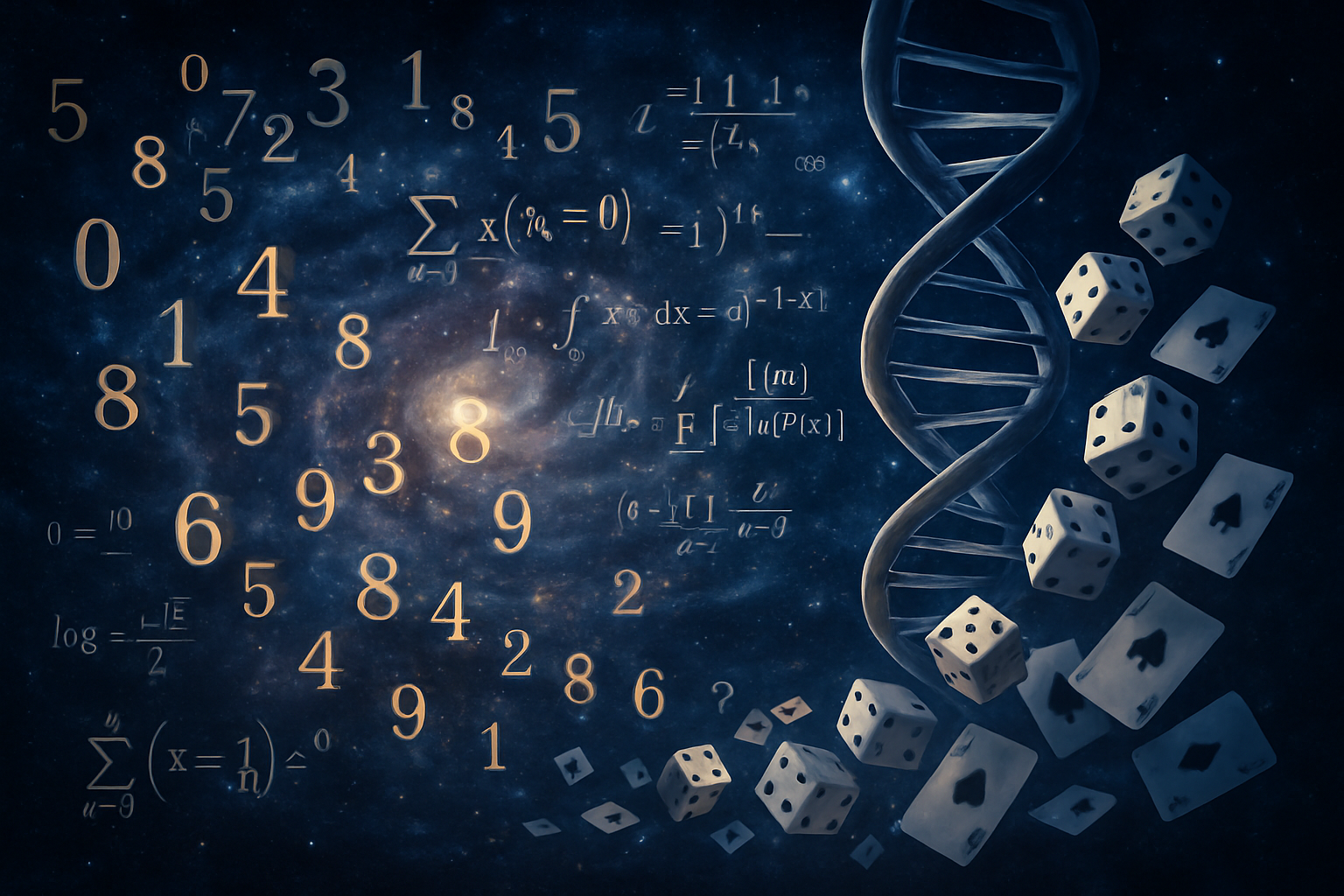
This article has nothing at all to do with health. It’s about numbers. Why write an article about really big numbers? Because I’m fascinated by the topic, and it’s my newsletter.
We all have an intuitive understanding that exponential numbers grow very rapidly. The “distance” from 10 to 100 (101 to 102) is a jump, and from 100 to 1000 (102 to 103) is a much larger jump, though each time the exponent grew by just one. With each step up in the exponent, the jump gets larger and larger, being 10 times larger than the previous jump. By the time the exponent is in the teens, each single step up in the size of the exponent is a colossally big jump in the size of the number it represents.
For instance, the probably of rolling nine 6-sided dice and all falling on the same number is about 1 in 107. If you had six 20-sided dice, the probability of rolling six of the same number on all dice would be about 1 in 1010, or 1 in 100 billion. If the entire lower 48 states in the US were covered with 1018 pennies, the pennies would cover the ground to a thickness of just over 2 inches. What if we increase that from 1018 pennies to 1020 pennies? That little change in the exponent has increased the penny layer over the US from 1.2 inches to about 17½ feet.
To step things up a bit, the number of possible different orders a 52-card deck could end up in after being randomly shuffled is unfathomably large, almost 1068. If a supercomputer started generating one after the other of each of those possible deck orders every millionth of a second since the Big Bang 13.8 billion years ago, it would by now be just over a third of the way through all those possibilities. Coincidentally, there are estimated to be approximately 1068 atoms in the Milky Way galaxy as well, so every atom in our galaxy could be assigned a unique shuffle of a standard 52-card deck. Crazy, that.
I’ll wrap this up by tying it to something a bit more down to earth. It has always irked me that evolutionary biologists never confront probabilities in a serious and systematic way. Our bodies have within them a minimum of 20,000 different functional proteins, with some estimates as high as 100,000. How did each one come about?
We are told by the experts in the field, and for decades I never questioned it, that each one came about through random mutations in DNA that produced lots of different proteins. Then natural selection “chose” the functional proteins out of the mix and thus the DNA that produced them got passed along the chain of generations through eons of time.
That’s the mythology of evolution, and it is completely unsubstantiated by any scientific evidence.
To my knowledge only one time has any researcher attempted to quantify how rare functional proteins are. In other words, in the pool of all possible proteins of a very modest 150 amino acids in length, how many of them would have the characteristics necessary to make them biologically functional? It is, of course, the most basic and obvious question any and all evolutionary biologist should be seeking an answer to because it is the crux of their entire field of study(!). After all, for random mutations to stumble upon functional proteins (which create new biological functions, which drive new forms, which are very essence of evolutionary theory), those proteins must have a non-trivial probability of being randomly generated in the first place.
Douglas Axe was working at Oxford University when he published both a theoretical and a laboratory study that actually gave a real-world estimate of how common (i.e. the “prevalence”) functional proteins are within the sea of all possible proteins. He found (and published) that, applying just one criteria for a functional protein, its prevalence among all possible proteins of the same length would be 1 in 1064. Adding one additional criteria dropped the prevalence to 1 in 1077.
Let’s apply this to what we know so far. Above I noted that there are about 1068 atoms in our Milky Way galaxy. Let’s say one of those 1068 atoms has a tag on it. The probability of randomly selecting a single atom in the Milky Way and it being the one that has the tag on it is 1 in 1068, which is 1 billion times more likely than the probability that random mutations with 150 amino acids result in a functional protein.
This is why evolutionary biologists never even attempt to deal with the likelihood of these “beneficial mutations” they claimed to be the beating heart of the evolutionary process.
A few scientists have offered rebuttals and qualifications to Axe’s findings, attempting to make the problem for evolution less severe than it seems on first blush. I find all of those attempts to be lacking any scientific merit, most of them being in the familiar form of , “Well, it could be that…”
If you disagree with my depiction of a “probability problem” that is central to evolutionary biology, feel free to let me know why in the comments.