
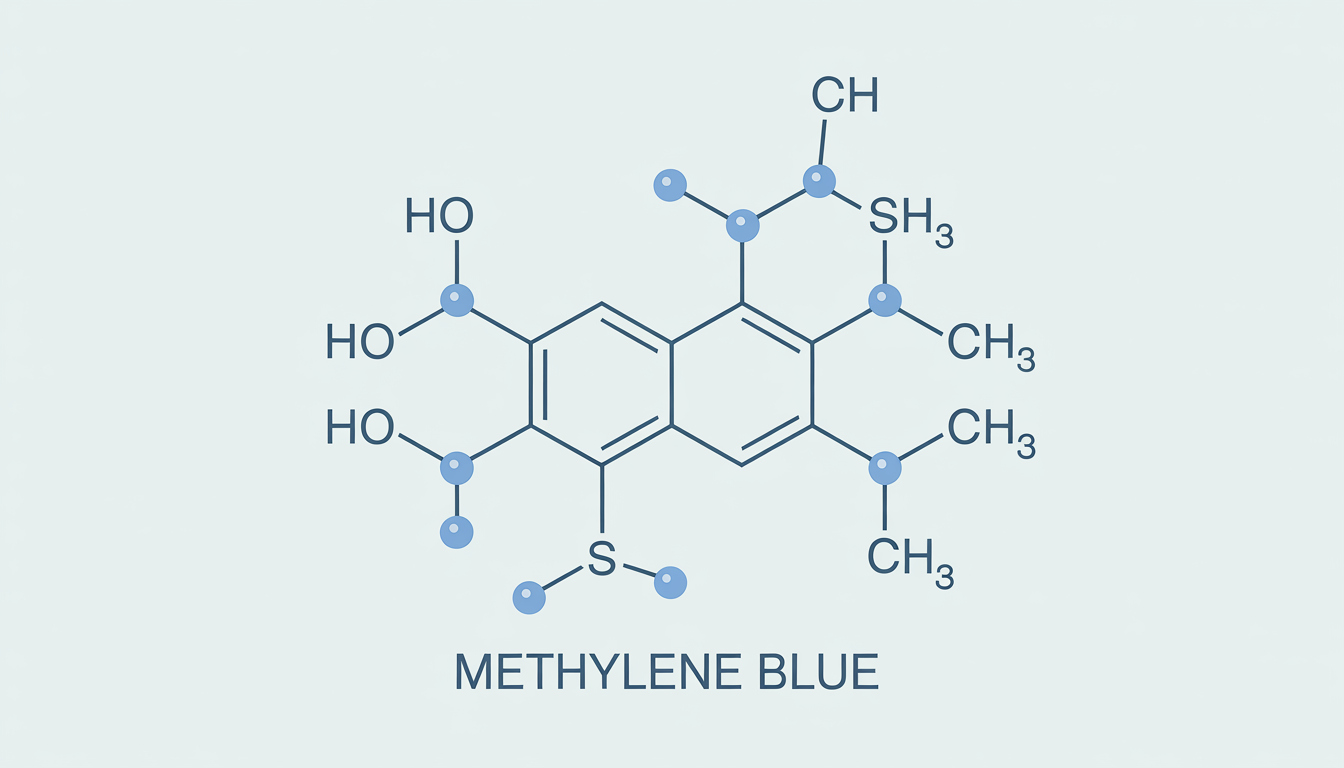
A few patients have recently forwarded me articles that describe some alleged grave dangers of taking methylene blue. This is a medication I have prescribed hundreds of times, and before prescribing any medication I spend some time researching both its risks and its benefits. When I looked into methylene blue some years ago I was surprised to find such a wide range of potential benefits and very little in the way of documented adverse effects.
Probably the most prominent writer cautioning against methylene blue recently has been Sayer Ji, founder of greenmedinfo.com. I have published essays on that platform before and I have always considered Sayer to be a reputable guy.
In his article on methylene blue, the first caution is about it causing a potentially life-threatening condition called serotonin syndrome. He cites a study published in 2010. However, the study he referenced actually doesn’t exist, which makes me wonder if he used AI to generate his references and was given a fake citation that he didn’t verify. There are case reports of methylene blue inducing serotonin syndrome. Every one of these involved the use of intravenous methylene blue given at a dose approximately 7 to 15 times higher than a typical oral dose.
I think it is disingenuous at best and deceptive at worst to use rare complications involving high IV doses to imply the same risks apply to relatively low oral doses.
Sayer’s next caution is that methylene blue can induce hemolytic anemia. Again, I clicked the link to the study he gave as a citation and it was a bogus link, taking me to a study on a completely unrelated topic. It is almost certain that he used AI to do his research, then didn’t double check to be sure they were legitimate. There are case reports of the medication inducing hemolytic anemia. All of those involved IV administration, a few are in neonates, a few others are individuals given methylene blue because they were being treated for poisoning by some other chemical and it worsened their condition. The point is, using these situations as a caution against low-dose oral methylene blue outside the context of emergency medicine is, in my opinion, deceptive and dishonest.
To give just one more example of the fear-mongering his article engages in, his next reference is to a study showing that methylene blue can have toxic effects on the brain and nervous system. His citation is to a study on rats that explicitly states that it used “high-dose” intravenous methylene blue to assess its impact on neurons. The relevance of such a study to low-dose oral intake is not apparent to me. Lots of medications and even supplements can become toxic at high doses – especially when delivered intravenously – while being completely safe at low doses.
A few others besides Sayer have published articles cautioning against use of methylene blue. They all are using pretty much the same arguments and citing the same intravenous studies to warn against side effects from oral intake. I have found methylene blue to be an enormously beneficial medication for many patients, often bringing dramatic relief from brain fog, fatigue, and/or depression. I do not prescribe medications haphazardly. I believe methylene blue, prescribed judiciously, can offer significant benefit to many patients, and do so safely. It is unfortunate that some prominent voices in the alternative medicine community have used largely irrelevant citations to build a case against this valuable therapy.


Hi Dr. Nigh,
Can you speak to the MAO and G6PD variants, which have been cited as reasons to avoid methylene blue? I have MAO TT (slowest), COMT AA (slowest) and DRD2 GG (highest), which has made me wonder whether methylene blue is OK for me. I’m also half Puerto Rican, and people with Mediterranean ancestry seem to have the G6PD variants.
Here’s where I’m getting some of this info from:
https://www.geneticlifehacks.com/methylene-blue-genetic-connections-and-research-studies/
I also read that if you’ve had cyanine poisoning, methylene blue could be problematic. I recently ate the kernal of a nectarine pit (which resembled an almond), and learned afterwards that these contain sometimes problematic amounts of cyanine.
Thanks!
Diana
Hi Diana,
I think the same thing applies regardless of the genetics: intravenous MB can cause problems. Low-dose/oral MB, very very unlikely to be a problem.
I have tested hundreds of patients for G6PD levels in their blood over the past few decades, something you have to do before you can give high-dose vitamin C IV, and for the same reason: it can cause hemolysis in patients that don’t have enough of that enzyme. Through all of those tests, only once did I find a patient who actually didn’t have enough. Now, it is guaranteed that some unknown number of those patients I tested had some genetic SNPs in their G6PD gene. So the issue is not the genetic variant, but what are the actual G6PD levels. If you are interested it is a very straight forward test to run through any standard lab. I use Quest.
The same concept applies to the other SNPs in my opinion. Keep in mind that MB was being prescribed for decades prior to anyone being tested for any SNPs. It was surely given to lots of people with SNPs in all these genes. And in spite of that, there are very very few reports of toxicities or complications even when given intravenously, and none at all I can find that are conclusively shown to be caused by oral administration (which is itself typically prescribed at a dose 10 to 20 times higher than the dose I most commonly recommend for patients).
I hope that clarifies.
Greg